A commercial fit-out or a multi-unit rough-in can do more for your year than a month of callouts. But bigger jobs don't just mean more work. They change how you get paid, when you get paid, and how much you carry in between.
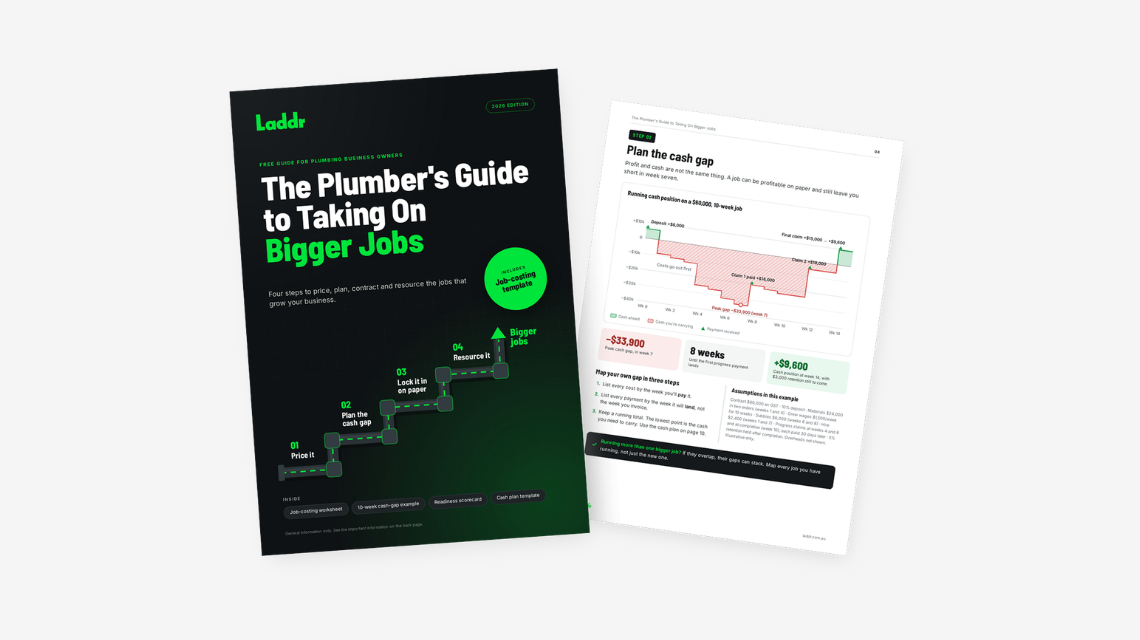
On a bigger job, you usually fund the work before the job funds you. On the $60,000 example job in our guide, that means carrying $33,900 at the lowest point. The guide walks through four steps to plan for it before you sign:
1. Price it properly
2. Plan the cash gap
3. Lock it in on paper
4. Resource it
Download the free Plumber's Guide to Taking On Bigger Jobs →
None of that has to stop you taking on bigger work. It just means planning for it before you sign. Here’s how, in four steps.
On a callout, a pricing mistake costs you an hour. On a ten-week job, it can cost you the whole margin. Most underquoting starts with labour. Once super, on-costs and non-billable time are in, your true cost per hour is a lot higher than the wage. The guide shows you how to work out yours, plus the costs most often left off bigger-job quotes.
Profit and cash aren't the same thing. In the guide's example, materials and wages go out from week one, but the first progress payment doesn't land for eight weeks. Two simple changes cut that gap by $12,000. The guide shows which two, and how to map the gap on your own job.
On bigger jobs, the contract decides when you get paid. Payment schedules, variations and retention all need to be in writing before work starts. A verbal "yeah, just do it" is the hardest money to collect.
Winning the job is half of it. The other half is delivering it without dropping the regular customers who keep your cash moving. The guide has a quick crew-hours check to see if the job fits.
Bigger jobs can grow your business, but they test your cashflow. Know your numbers and your peak gap before you sign, not halfway through the job.
If your business has a Reece trade account and an active ABN, you can apply for a Laddr line of credit from $3,000 to $250,000. Assessment is based primarily on your Reece trading history. Call our team on 1800 522 822.
This article is general information only and isn't financial, legal or tax advice. All examples are illustrative. Credit provided by TruePillars Pty Ltd (ABN 36 603 933 508) and its subsidiaries. Eligibility criteria and terms and conditions apply.